

Real Cost of Solar: Payback Periods Shorter Than You Think?
For years, one of the biggest misconceptions we hear from homeowners is this:
“Solar takes decades to pay for itself.”
At Forme Solar Electric, we’ve been installing and repairing solar systems across Southern California long enough to know this just isn’t true. In fact, most of our customers see a return on their solar investment in five to seven years, not decades. Add in rising electricity rates, California’s time-of-use (TOU) pricing, and the falling cost of solar technology, and the payback period has never been shorter.
This post breaks down the real cost of solar ownership, shares case studies from local homeowners, and explains why adding battery storage makes your system even more valuable.
Why People Think Solar Costs Takes Too Long to Pay Off
The myth of the “decades-long payback” comes from outdated assumptions:
- Old system costs: Ten years ago, solar installations could cost nearly double what they do today.
- Flat electricity rates: Utility rates have since spiked — in California, some have doubled in just the last decade.
- Inaccurate ROI calculators: Many online tools use outdated data and assume you’ll only save on daytime energy, not factoring in batteries and TOU shifts.
The truth is, with current incentives, improved efficiency, and skyrocketing utility bills, solar is one of the smartest financial decisions a homeowner in Southern California can make.
How to Calculate Your Solar Payback Period
The payback period is how long it takes for your energy savings to equal the cost of your solar installation. After that point, your system is essentially producing free power.
The formula is simple:
System Cost – Incentives ÷ Annual Utility Savings = Payback Period
Let’s break this down with real examples from our customers.

Case Study #1: Anaheim Homeowner With 7 kW Solar System
- System size: 7 kW rooftop solar
- Total cost after incentives: $18,500
- Monthly bill before solar: ~$280 ($3,360 annually)
- Monthly bill after solar: ~$40 ($480 annually)
- Annual savings: $2,880
Payback period: $18,500 ÷ $2,880 ≈ 6.4 years
This homeowner reached “break-even” in just over six years. With panels warrantied for 25 years, that means nearly two decades of bill-free energy.
Case Study #2: Irvine Homeowner With Solar + Battery
- System size: 9 kW rooftop solar + 13.5 kWh battery
- Total cost after incentives and SGIP rebate: $25,000
- Monthly bill before solar: ~$400 ($4,800 annually)
- Monthly bill after solar + battery: ~$50 ($600 annually)
- Annual savings: $4,200
Payback period: $25,000 ÷ $4,200 ≈ 6 years
This customer chose to add a battery, not just for backup power during outages, but to avoid expensive 4–9 p.m. TOU rates. By storing solar energy during the day and using it when rates peak, the battery cut their payback period nearly in half compared to solar alone.
Rising Electricity Rates Are Shortening Solar Paybacks

Southern California utility rates have risen by over 70% in the past decade, and rate hikes show no signs of slowing.
- In 2014, the average cost per kWh was around 16¢.
- Today, many homeowners are paying 30¢–40¢ per kWh.
Every time rates rise, solar becomes more valuable. A system that once shaved $150 a month off your bill might now save you $300 or more without any additional investment.
The Time-of-Use Factor
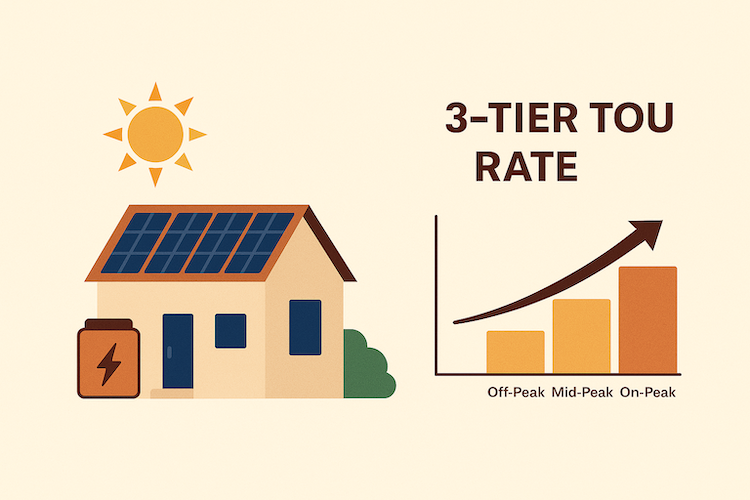
California utilities now use time-of-use (TOU) rates, charging the most when people use electricity the most:
- Peak hours (4–9 p.m.): 40¢–50¢ per kWh
- Off-peak hours (overnight): 20¢–25¢ per kWh
This has a huge impact on your solar payback. Without a battery, your panels are generating during the day, but you’re still paying high rates when you get home in the evening.
With a battery storage system, you can:
- Store excess solar energy during the day.
- Use it during peak hours instead of paying inflated rates.
- Slash your payback period by 1–3 years.
Federal and Local Incentives
Another reason solar pays back faster today? Incentives.
- Federal Tax Credit (ITC): Homeowners can claim 30% of system costs back as a tax credit.
- SGIP Rebate (Self-Generation Incentive Program): California homeowners adding batteries can receive thousands in rebates.
- Property Tax Exclusion: Solar doesn’t raise your property taxes, even though it boosts home value.
Together, these programs can cut the upfront cost by 25–40%, shaving years off the payback period.
What If the Federal Tax Credit Disappears?
One of the biggest drivers of solar adoption today is the 30% federal tax credit (ITC). But what happens if it goes away? Would solar still make financial sense in Southern California?
The answer is yes — and here’s why:
Case Study #3: Irvine Homeowner With Solar + Battery (No Incentives)
Many homeowners ask: “Would solar still make sense if incentives disappeared?” To answer that, let’s take the exact same scenario from Case Study #2 but remove all financial incentives.
- System size: 9 kW rooftop solar + 13.5 kWh battery
- Total cost without incentives: $35,700 (instead of $25,000 with tax credit and SGIP rebate)
- Monthly bill before solar: ~$400 ($4,800 annually)
- Monthly bill after solar + battery: ~$50 ($600 annually)
- Annual savings: $4,200
Payback period without incentives: $35,700 ÷ $4,200 ≈ 8.5 years
Even without the federal tax credit, this homeowner still breaks even in just over eight years. With panels lasting 25–30 years, that’s nearly two decades of free energy.
Why Solar Payback Periods Stay Short
- Rising rates are doing the heavy lifting. California utilities continue to raise rates, sometimes twice in the same year. Every increase shortens your payback.
- Panel costs are dropping. The average cost per watt of solar has fallen by nearly 70% in the past 15 years, making systems more affordable even without tax credits.
- Battery storage compounds the savings. By avoiding high TOU rates, you lock in even more value.
So while the federal tax credit is a huge benefit today, it’s not the only reason solar pays back quickly. The math still works in your favor — especially in high-rate regions like Southern California.
What Happens After Payback?
This is where solar gets exciting. Once your system has paid for itself, your electricity costs are essentially eliminated, aside from a small utility connection fee (often $10–$15 a month).
That means if your system lasts 25 years — and most last 30+ with proper maintenance — you could be looking at 15–20 years of free energy.
For our Anaheim customer, that’s nearly $60,000 in lifetime savings. For our Irvine homeowner with the battery, it’s closer to $90,000.
The Hidden Value of Solar: Peace of Mind
The financial benefits are clear, but many customers tell us their favorite part of going solar is peace of mind:
- Protection from rising rates: Once you own your power, utility hikes don’t affect you the same way.
- Backup power: With a battery, you can keep your lights, fridge, and medical devices running during blackouts.
- Higher home value: Zillow studies show homes with solar sell for 4% more on average.
Why Work With a Local Solar Company?
Choosing solar is a big decision. While national installers advertise low prices, many customers find themselves frustrated with poor service, slow response times, or systems that fail and are left unserviced.
At Forme Solar, we take a different approach:
- We specialize in solar repair as well as installation, meaning we know how to avoid the mistakes other installers make.
- If you aren’t completely satisfied, we’ll remove your system and provide a full refund.
- We live and work in the same communities as you, from Fullerton to Irvine, Los Angeles to Riverside. So when you need help, we’re right here.
Final Thoughts: Solar Pays Off Faster Than Ever

The idea that solar takes “decades” to pay off is outdated. Today, most Southern California homeowners see a return on their investment in five to seven years, and with incentives and battery storage, it can be even faster.
When you add in protection against rate hikes, backup power security, and increased property value, the question isn’t “Can I afford solar?” — it’s “Can I afford not to?”
Call to Action
At Forme Solar Electric, we’re proud to be your local solar company helping families across Southern California save money, stay safe, and achieve energy independence.
Ready to see your payback period? Contact us today at 714-694-2262 for a free, no-obligation solar estimate and discover how quickly solar can pay off for you and your home.
Recent Posts
- From Solar Installation, HVAC to Roofing: Home Services Done Right
- Forme Solar Recognized as 2025 Top Solar Contractor by Solar Power World
 The Next Level in Home Battery Systems? Meet EcoFlow Ocean Pro
 The Government Just Set a HUGE Cloud Over the Solar Industry Why You Need to Act Now
 The Simple Guide to Choosing the Best Solar Panels in 2025
 Ask These 10 Questions Before You Choose a Solar Company
 Should You Get Solar Battery Storage? A Comprehensive Guide to Battery Benefits and ROI
 Sunnova Energy Files for Bankruptcy
 How Many Solar Panels Do You Actually Need? Don’t Waste Your Money
 Tesla Powerwall 3 Overview From a Certified Installer
 New Franklin aPower 2 is a Game Changer – FranklinWH Battery
 How to Choose the Right Solar Panel Warranty: What to Know
 Can You Expand an Existing Solar Panel System?