


Government Regulation and Impact on the Solar Industry
I’m Nick from Forme Solar Electric, and I made a video laying out urgent news that affects every homeowner thinking about going solar. In short: a recent change in federal policy means the big 30% federal solar tax credit that made solar a no‑brainer for so many families is scheduled to drop to zero on January 1, 2026. That’s not a hypothetical — it’s a real change, and the deadline to qualify for the full 30% is based on when your system is fully installed, not when you sign a contract or write a check.
This article breaks down everything you need to know: what changed, why it matters for Southern California homeowners, a realistic installation timeline, how to make sure you lock in the savings, and practical steps to prepare so you don’t get left behind. I’ll also explain how we do things differently at Forme Solar — because right now, the industry is about to change in ways that will leave some companies behind and reward others built to last.
Quick Summary: What just happened
For about 20 years homeowners who purchased their solar energy systems (paid cash or financed) were eligible for a federal investment tax credit (ITC) of up to 30% of the system cost. If your system cost $30,000, that meant up to $9,000 back as a federal tax credit — a huge incentive that dramatically improved the return on investment for solar.

Under a new federal bill that just passed, that 30% credit will drop to 0% on January 1, 2026. The crucial point many people overlook is how the eligibility cutoff works: to qualify for the full 30% credit, your solar system must be fully installed, commissioned, and operational on your roof before December 31, 2025. Not merely contracted. Not merely paid. Installed and turned on.
"Your system has to be completely installed by December thirty first twenty twenty five. Not just signed, not just paid for, but fully installed, operational, and commissioned on your roof." — Nick, Forme Solar
Why the deadline is a big deal — and why it’s confusing
At first glance it’s easy to think: "I’ll sign a contract next month and save my spot." But solar projects don’t happen overnight. Between site surveys, engineering, permits, utility interconnection paperwork, the physical install, inspections, and final utility approval to turn the system on, the real timeline can be weeks to months. The federal rule ties the tax credit to the system being operational, which means the clock is on from the moment you decide to move forward.

In Southern California, where I work, the average timeline from signed contract to activation is typically between two and four months. That’s in normal conditions. With a surge of homeowners trying to beat a looming deadline, permit offices and utility interconnection queues can become heavily backlogged, stretching that timeline out even further.
The step‑by‑step reality of getting solar installed (and where time goes)
If you’re going to lock in the 30% credit and actually get your system running before Dec 31, 2025, you need to understand the process. Here’s the full sequence, why each step takes time, and reasonable ranges for how long each phase commonly takes in Southern California.
1. Initial consultation and site assessment — 1 to 2 weeks
We start with a site visit to assess your roof, shading, orientation, roof condition, and your electrical panel. That visit yields measurements, photos, and notes we need for engineering and system design. Depending on schedules, we often book these within days, but sometimes it takes a week or two to get a convenient appointment.

2. System design and engineering — 1 to 3 weeks
Once we have the site assessment, our engineering team takes the measurements and creates a full set of plans for the building department and for the utility interconnection. These plans include structural considerations for the roof, electrical one-line diagrams, equipment specs, and a layout for panel placement. Engineering time varies with project complexity: a simple single‑family home might be quick; homes with tricky roofs, extra electrical work, or battery backup require more time.
3. Permit application to the city or county — 2 to 4+ weeks
Those engineering plans go to the local building department for permitting. Some jurisdictions are fast; others take longer. Even under normal conditions you should expect at least a few weeks here. If the city has questions or requires plan corrections, it adds time. In a busy season, permit queues can lengthen to a month or more.
4. Utility interconnection application — weeks to months
This is the critical bottleneck in many parts of California. We submit paperwork to your utility (for example, Southern California Edison or San Diego Gas & Electric) for permission to interconnect your system and participate in net metering and export rules. Utilities often have their own queue and can take a long time to approve applications, especially when backlogs build.

When hundreds or thousands of homeowners try to jump into the queue at the same time (as many will do before a major policy deadline), the processing time can stretch out considerably. Historically, utility approval has added weeks or months to the timeline — and when you’re fighting a hard government deadline, those weeks matter.
5. Scheduling and performing the physical installation — 1 to 3 days
Once permits are in hand, the physical install of panels, racking, inverter, and battery (if applicable) typically takes one to three days for a standard residential system. Crew availability can influence scheduling, but the actual physical install is usually the fastest part of the process.
6. Final inspection by the city — typically within a week or two after install
After installation we request a final inspection from the local building department. Many offices complete inspections quickly, but some schedules may delay inspections by a few days or a week. Once the inspector approves the work, we get an inspection sign‑off that we then submit to the utility.
7. Final utility approval and authorization to operate — weeks to a few months
After the city inspection is complete and the inspection report has been logged, the utility still needs to grant final permission to energize the system. This step can be surprisingly slow: utilities check the interconnection paperwork, confirm the inspection sign‑off, and then issue a permission to operate (PTO). Depending on the utility’s backlog, this step can add several weeks or even a couple of months.
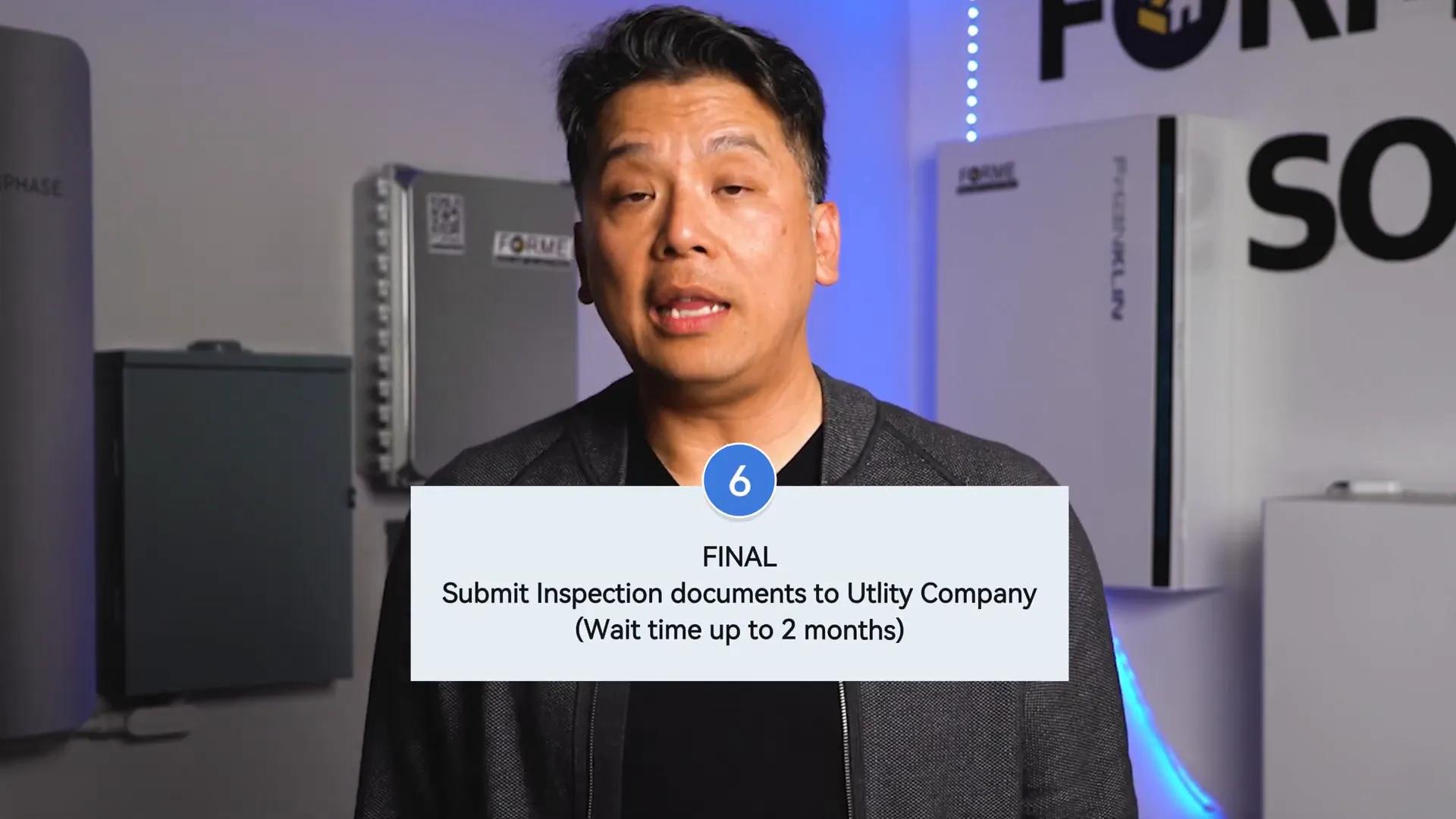
Because the 30% tax credit requires your system to be operational before the deadline, any delay in utility PTO is a potential deal breaker. That’s why we say if you want confidence of activation by December 31, 2025, you should sign a contract in September 2025 at the latest — and earlier if possible.
Why September contracts are the practical cutoff
Work backward from December 31, 2025. If the average contract-to-activation timeline is two to four months, then signing in September gives enough buffer for the typical process to complete. If anything slips — a permit revision request, a slow inspection line, a utility backlog — earlier contracts help protect you from missing the deadline.
In practice, the earlier you start, the better. Even if you’re optimistic about permit processing and utility timing, the surge of homeowners trying to beat the deadline will likely create extra congestion. Signing in September, or sooner, maximizes the chance your system will be active and eligible for the full tax credit.
Real numbers: an example of how the 30% credit works
Let’s do a concrete example so the benefit is clear. Suppose your system costs $30,000. Under the 30% tax credit:
- You would be eligible for up to $9,000 in federal tax credit.
- The effective cost after the credit could be $21,000 (before any state incentives or rebates).
- That $9,000 drop in upfront effective cost can dramatically shorten your payback period and increase your return on investment.
With the 30% credit scheduled to drop to zero in 2026, families who delay installation after 2025 will lose that $9,000 (or whatever 30% of their system cost is) advantage. The financial math changes significantly: what used to be a nearly automatic financial win becomes a more evaluative decision where payback and incentives will vary more by case.
Why this matters especially in Southern California
Electricity rates in Southern California are among the highest in the country. Year after year utility rates increase, and those higher rates make the economics of home solar that much more compelling. Solar gives homeowners control over their electricity costs and protects them from future rate hikes.

Here’s another practical point: when solar is widespread and financially attractive, it acts as a competitive check on utilities. If utilities raise rates aggressively, homeowners can reduce their reliance on the grid with solar and battery storage. This pressure encourages more reasonable pricing and policy decisions. Remove or reduce financial incentives and that competitive pressure weakens — which can affect rate dynamics over time.
What will change after the 30% credit drops to zero?
Solar isn’t disappearing in 2026. People will still want to control energy costs, protect against rising utility rates, and shift to clean energy. But some important shifts are likely:
- Cost to the homeowner will be higher on day one — without the 30% federal credit, the upfront effective price of PV systems goes up substantially.
- Return on investment timelines will lengthen for many families, depending on system cost, local electricity rates, and any remaining local/state incentives.
- Some solar companies that rely heavily on the incentive-driven volume may struggle to adapt; we expect consolidation in the industry and more companies to go out of business.
- Companies that do everything in-house — sales, design, installation, repairs, and long-term service — will be better positioned to survive and support customers long term.
In short, solar will remain a smart choice for many households, but it will no longer be the near-universal financial "no-brainer" it was while the 30% credit was available.
How we handle the rush and why it matters who you choose
At Forme Solar, we do sales, engineering, installation, and repairs under one roof. We started as repair specialists, which means we’ve built our business around reliability, field knowledge, and standing behind the systems we install.
Why does that matter? In a market adjustment like this, the companies that survive will be those that can deliver end-to-end service and long-term support. If a company is primarily a sales organization that subcontracts out design and installation, or if it disappears after an installation, homeowners can be left without the support they need in year five or year ten when issues inevitably arise.
We know the common mistakes that trip up installations and we’ve fixed them for customers who bought elsewhere. That experience informs everything we do: better designs, smarter installations, fewer callbacks, and quicker service if something does go wrong.
Smart steps to take right now, a homeowner checklist
If you’re ready to act before the 30% credit disappears for good, here’s a practical checklist to move forward efficiently and protect your eligibility:
- Get a site assessment as soon as possible. The sooner we evaluate your roof and electrical setup, the sooner engineering can begin.
- Ask your installer to guarantee a 2025 installation timeline. If an installer can’t commit to having your system operational before Dec 31, 2025, find one who will.
- Clarify what “installed” means for the tax credit. You need the system commissioned and operational — with final inspection sign‑off and utility permission to operate — before Dec 31, 2025.
- Confirm engineering and permit timelines in writing. Understand who is responsible for each step and expected timeframes for plan approvals and permit issuance.
- Ask about utility interconnection experience and track record. Experience navigating the local utility processes can drastically reduce delay risk.
- Lock in financing or payment terms early. Don’t let financing hold you up in the queue; get pre‑approved or have payment plans ready.
- Prepare your roof and electrical panel needs. If your roof needs repairs or the panel needs upgrades, schedule those proactively so they don't block permitting or inspection.
- Document everything. Keep copies of permits, inspection approvals, and the utility permission to operate. You’ll need documentation to claim the tax credit.

Important Questions to Ask the Company you Work With
Not all solar companies are created equal. When you get quotes and proposals, ask these questions to evaluate their reliability and ability to meet the deadline:
- Do you handle engineering, permitting, installation, and service in-house?
- Can you guarantee an installation and activation date before December 31, 2025?
- What is your historical timeline from contract to PTO in my city and utility territory?
- How do you handle permit plan corrections or utility request responses?
- What documentation will you provide to support my federal tax credit claim?
- Who services the system if there’s a problem after installation?
- Do you provide a workmanship warranty and equipment warranties? What happens if the company goes out of business?
The answers to these questions will tell you a lot about whether an installer is a long-term partner or a short-term vendor trying to close deals while the incentive exists.
Financing Considerations and What to Watch For
Financing can make a big difference in how affordable solar is today. If you plan to finance, do it early enough that financing approval doesn’t delay your project. Ask lenders about timing to ensure funds will be available when needed.
Another important detail: the federal tax credit is applied against your federal tax liability the year the system is placed in service. If your tax liability is lower than the credit amount, there are rules about carrying forward credits, so talk to your tax advisor. But the main point for homeowners is this: missing out on the credit because your system isn’t activated on time is an avoidable loss if you plan correctly.
Alternatives if you Miss the 2025 Deadline
If you can’t get your system commissioned by Dec 31, 2025, you still have options — you just won’t get the full 30% federal credit. Some possibilities include:
- Look for state and local incentives that may remain in place even after the federal credit ends.
- Consider smaller, staged installations or battery-only projects if they qualify for other incentives.
- Negotiate pricing and financing that compensate for the lost federal credit — some installers will offer price adjustments during the transition to help customers move forward.
- Wait and watch for new policy updates — sometimes new legislation or targeted programs appear to offset changes, though nothing is guaranteed.
Every home and family budget is different. Even without the 30% credit, solar can still make sense for many households depending on the system cost, electricity rates, and long-term savings goals—but the math will be less immediately compelling.
Common mistakes homeowners make in a rush and how to avoid them
When there’s a deadline and demand spikes, mistakes happen. Here are the most common pitfalls we see — and practical advice to avoid them:
- Rushing to sign with a company that can’t deliver: If an installer says "sign now" but can’t back up the installation timeline with capacity and documented experience, you may miss the deadline anyway. Ask for proof of recent similar projects and references.
- Assuming paperwork alone secures the credit: Remember, being "in the queue" with an application is not the same as being commissioned. The system must be operational and permitted.
- Neglecting roof or electric upgrades: If your roof needs work or your electrical panel is outdated, factor that into the timeline immediately. Delaying roof fix or panel upgrades can push you past the deadline.
- Choosing the lowest price without checking warranties: A low price might mean low-quality equipment or poor workmanship. Short‑term savings can become long‑term headaches.
- Not getting documentation: Keep detailed copies of permits, inspection signoffs, and the utility permission to operate — you’ll need these for tax filings.
Why Experience Matters: A story from our days as repair specialists
We started as a repair company. We fixed systems installed by others, and that experience taught us two invaluable lessons:
- Many installations cut corners in design or wiring that don’t show themselves immediately but cause problems later.
- Long-term serviceability matters more than a cheap initial price. When a system needs service in five or ten years, you want a company that will still be around to help.
Because of that history we design and install systems with maintenance and real-world longevity in mind. We know what gets missed and we proactively avoid those errors. In a market shift, that kind of institutional knowledge is what keeps customers protected.
How we Guarantee a 2025 Installation Timeline
Because the deadline matters so much, here’s how we approach guaranteed 2025 timelines for customers who act now:
- Prioritize early site visits and fast engineering turnarounds.
- Maintain direct relationships with local permitting offices to move plans through more efficiently.
- Submit utility interconnection paperwork promptly with accurate details to reduce review cycles.
- Allocate installation crews and materials for guaranteed schedule windows.
- Track permit and inspection status closely and communicate proactively with customers.
We won’t guarantee an installation timeline unless we genuinely believe we can meet it considering permit and utility conditions. If we can’t commit to a 2025 operational date, we’ll tell you up front so you can make an informed decision.
Net Metering and Battery Storage: Planning for the future
Many customers ask whether they should add battery storage when they go solar. Batteries aren’t required to claim the federal tax credit for solar panels (though batteries that are charged exclusively by solar may qualify under certain rules), but adding storage can protect your household against outages and give you more control over when you use the solar energy you produce.
Net metering rules determine how much credit you receive from exporting excess solar to the grid. These policies are set by utilities and regulators and can change over time. If you’re planning a system, talk with your installer about local net metering rules and whether a battery could improve your long-term savings or energy resilience.
Long-term Economics: How to think about solar after incentives change
Without the 30% federal credit, homeowners need to pay closer attention to the long-term economics. Key variables include:
- Local electricity rates and expected future rate increases.
- System cost after all available rebates and local incentives.
- Equipment warranties and expected system life (panels and inverters).
- Net metering policy and compensation for exported energy.
- Whether battery storage is added and how it changes energy self-consumption.
Even with the federal credit gone, many homeowners in high-rate regions like Southern California will find that solar pays for itself over time — but the payback period will likely increase, and each project will require more careful analysis.
Frequently Asked Questions (FAQs) and Straightforward Answers
Q: Does signing a contract before Dec 31, 2025 count for the 30% credit?
A: No. The federal credit requires the system to be placed in service (installed, inspected, and activated) before Dec 31, 2025. A signed contract or partial payment does not qualify.
Q: What if my system is installed but the utility delays permission to operate past Dec 31?
A: This is exactly the risk homeowners need to manage. Because utilities can lag, the safest approach is to start early enough that both permit and utility steps can be completed in time. We factor utility timing into our timeline guarantees.
Q: Will any parts of the federal incentive remain after 2025?
A: The new bill as explained by recent updates reduces the 30% credit to zero starting January 1, 2026. Local or state incentives may still be available, but the large federal incentive that applied broadly is scheduled to end. Keep an eye on local programs, as some states or municipalities sometimes introduce replacement incentives.
Q: I don’t pay enough federal taxes to use the full tax credit — what happens?
A: Tax credits are applied against your federal tax liability. There are provisions for carrying credits forward in some cases; check with your tax advisor. The point remains that missing the deadline means missing the potential tax benefit entirely.
Q: How many months does it take from contract to activation?
A: In Southern California, typical timelines are two to four months in normal conditions. Given likely backlogs ahead of a major deadline, plan for the longer end of that range unless you can commence early and your installer has proven experience expediting permits and utility processes.
Final thoughts — Why now is the time to act
If you’ve been thinking about going solar and saving on rising electricity costs, this is the moment to move from considering to acting. The 30% federal tax credit has been a major driver of solar adoption across the country. With that incentive set to drop to zero in 2026, anyone who wants to secure those savings needs to have their solar system fully installed and commissioned on their roof by Dec 31, 2025.
September 2025 is a sensible practical cutoff for signing contracts in Southern California if you want confidence in a 2025 activation date. But the earlier you start the less risk you take of permit or utility delays knocking you past the deadline.
At Forme Solar, we’re here to help homeowners navigate this exact scenario. We offer free custom quotes, handle everything from sales and system design to installation and long-term service, and we’ve built our business to last. If you want clarity on your costs, estimated savings, and a reliable installation timeline for 2025, get your assessment scheduled sooner rather than later.
What to do next
Take these three simple steps right now:
- Schedule a site assessment so engineering can begin ASAP.
- Ask your installer for a written timeline commitment for 2025 activation.
- Gather roof and electrical information to speed up permitting and approvals.
With the federal incentive landscape changing, delaying a decision could cost thousands of dollars in lost federal tax credits and put you at the mercy of rising utility rates. If you want help running the numbers and understanding your options, we’re local Southern California solar experts and we’ll walk you through each step.
Conclusion: Keep your family locked into cleaner, more affordable energy
Solar isn’t going away in 2026. But the financial case for many families will change dramatically without the 30% federal credit. If you care about long-term energy costs, resilience, and keeping your household protected from future utility rate shocks, this is a pivotal moment.
Don’t wait until September or October to find out you missed your chance. Demand is already surging, and installation timelines will only get longer as homeowners rush to lock in the incentive. If you want to move forward and secure the 30% federal tax credit, act now and get the process started so your system will be operational before the 2025 cutoff.
If you want a free, no-pressure quote showing your system cost, estimated savings, and an achievable installation timeline, reach out and get your consult scheduled. We’ll show you exactly what the numbers look like for your home and guarantee our 2025 installation timelines when we commit to them.
Let’s get your family locked into clean, affordable energy before the biggest solar incentive in recent history disappears.
Recent Posts
- From Solar Installation, HVAC to Roofing: Home Services Done Right
- Forme Solar Recognized as 2025 Top Solar Contractor by Solar Power World
 The Real Cost of Solar: Why Payback Periods Are Shorter Than You Think
 The Next Level in Home Battery Systems? Meet EcoFlow Ocean Pro
 The Simple Guide to Choosing the Best Solar Panels in 2025
 Ask These 10 Questions Before You Choose a Solar Company
 Should You Get Solar Battery Storage? A Comprehensive Guide to Battery Benefits and ROI
 Sunnova Energy Files for Bankruptcy
 How Many Solar Panels Do You Actually Need? Don’t Waste Your Money
 Tesla Powerwall 3 Overview From a Certified Installer
 New Franklin aPower 2 is a Game Changer – FranklinWH Battery
 How to Choose the Right Solar Panel Warranty: What to Know
 Can You Expand an Existing Solar Panel System?